

Know who's on call. Reach the right person—in seconds.
Who's On Call brings schedules and contact numbers into one reliable place, so staff spend less time searching and more time moving care forward.
A practical walkthrough built around your hospital's workflow.
Already in daily use at a full-service hospital in Puerto Rico
Used every shift since 2025. Figures as of September 2026.
- 330+providers listed
- 1,000+searchable contacts
- 1 yearcontinuous production
The same verified coverage, wherever you check it.
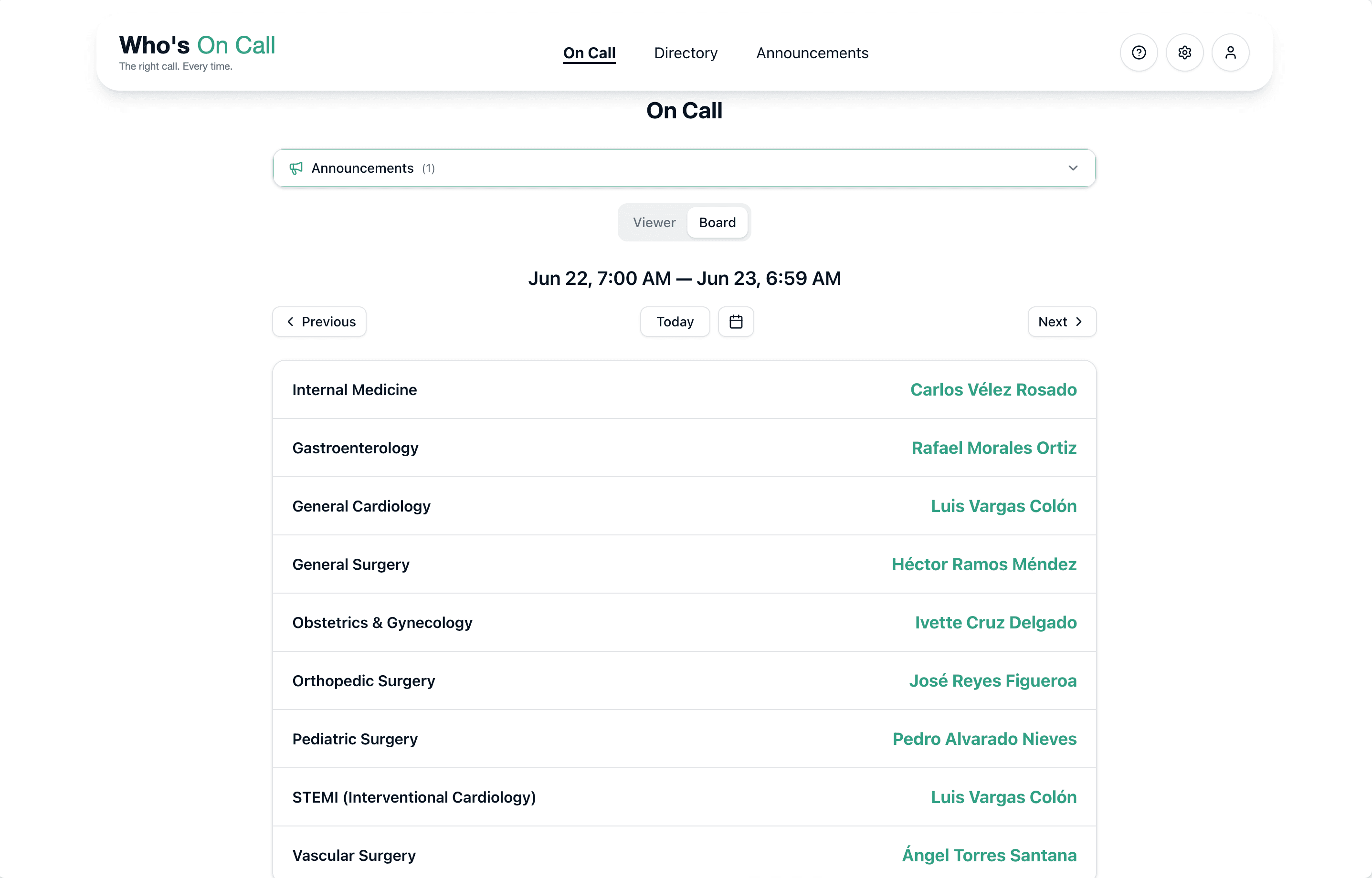
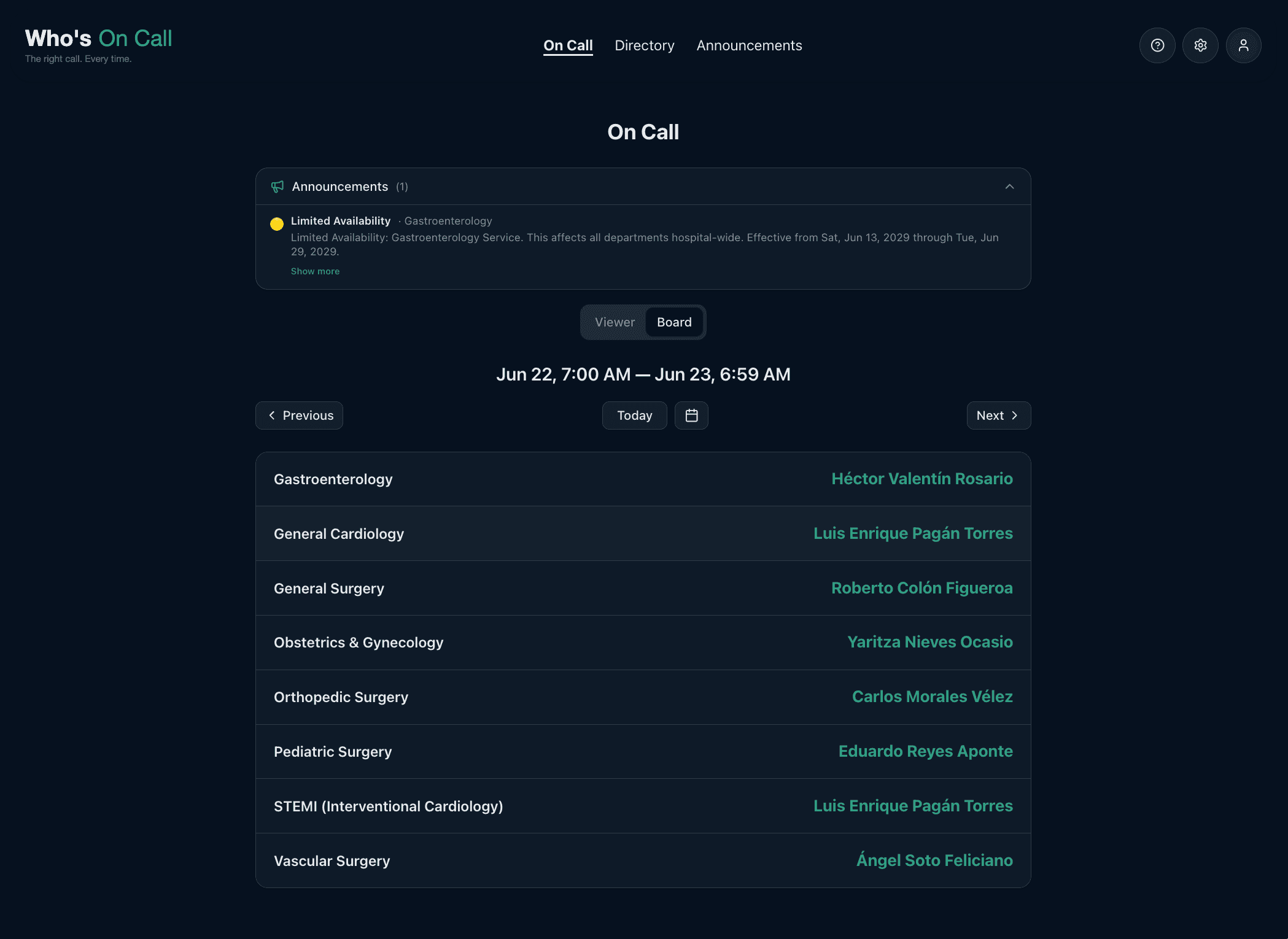
From “Who's on call?” to the right person.
One simple path, whether someone is checking from the emergency department, the floor, or an office.
- 1
Bring the schedule together
Use your current schedules or manage coverage directly in Who's On Call, including rotations and last-minute changes.
- 2
Make the answer accountable
The hospital decides who owns coverage for each service. Who's On Call gives them one place to set it and records every change, so there is a single authoritative answer and a clear trail behind it.
- 3
Search, find, call
Look up a service, name, or role from a phone or computer and get the contact you need.
Simple for staff. Practical for the institution.
A useful tool has to fit the systems, people, and responsibilities already in place.
Works with your current process
Start with the schedules you already use. You do not have to replace the hospital's core systems.
Responsibility stays with the hospital
Your institution names the schedulers who own coverage. Who's On Call is the system of record that makes their decisions visible and traceable.
Gets people to the answer quickly
Open the app, search the service, find the on-call clinician, and make the call.
One license per institution. Unlimited users.
No per-seat charges and no cost increase as your staff grows. Every clinician, scheduler, and operator at your facility is covered by the same institutional license.
“Since the app arrived at our institution, it's been a game changer. It's so much easier to know who I need to consult.”
Coverage information only. No patient data.
Who's On Call holds provider coverage schedules and hospital contact information. Nothing else.
No patient data
There is no patient record, no chart, no clinical note, and no field anywhere in Who's On Call that asks for patient information. Provider names and extensions are staff directory information, not patient data.
Approved access only
Registration is closed. An administrator at your institution approves every account and controls who can view schedules, update coverage, and manage the system.
A record of changes and of access
Coverage updates record what changed, when, and who made the change. The audit trail also covers access: who viewed a schedule, who copied a contact, and who initiated a call.
Nothing for your team to build
No interface engine, no EMR integration project, no server to provision. Who's On Call runs alongside your existing systems rather than inside them.
Our security and service documentation covers hosting and data residency, subprocessors, encryption, the access and role model, audit logging scope, incident and breach notification, backup and recovery targets, uptime commitments, and support coverage. It states plainly which controls are implemented today, which are contractual commitments, and which are planned.
This should be an easy question to answer.
After years of watching clinicians search through binders, old messages, and phone chains, I built Who's On Call around one basic need: a clear, current answer when someone asks who is covering a service. That answer should be easy to find—especially on the hardest shifts.
Carlos Gonzalez, MDPracticing emergency physician in Puerto Rico
Founder · Datum Systems
See how Who's On Call could fit your hospital.
We'll walk through the live product, answer your questions, and outline what a practical rollout could look like. It takes 20 minutes.